- All
- Product Name
- Product Keyword
- Product Model
- Product Summary
- Product Description
- Multi Field Search
Views: 0 Author: Site Editor Publish Time: 2026-06-19 Origin: Site

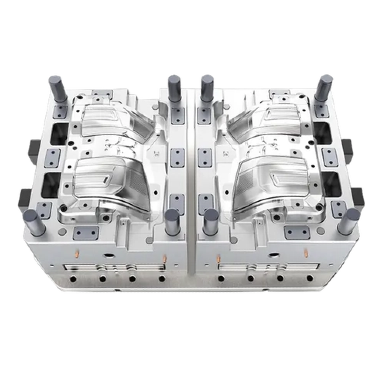
Not all molds are equal. A standard mold might produce acceptable parts for a month. A Precision Auto Lamp Injection Mold produces perfect parts for years. But what makes a mold “precision”? What specific features separate a high-quality automotive lighting mold from a commodity tool? This guide breaks down the essential features—from cooling design to venting to surface finish—that define a High-Precision Mold for headlights, signal lights, and light guide strips.
Auto lamp parts are not hidden under the hood. They are the face of the vehicle. A headlight with hazy glass or a signal light with visible flow marks looks cheap. Worse, optical defects can reduce light output, creating safety issues. Therefore, a Precision Auto Lamp Injection Mold must deliver:
Optical-grade surface finish – No scratches, no dull spots.
Dimensional stability – Every part fits the housing perfectly.
Consistent wall thickness – No warpage or stress marks.
Long tool life – Thousands of cycles without degradation.
Achieving these requires specific design and manufacturing features.
The foundation of any High-Precision Mold is the steel. Automotive lamp molds typically use:
H13 hot-work tool steel – Excellent toughness, good wear resistance, withstands high PC melt temperatures.
S136 stainless steel – Superior corrosion resistance, ideal for high-humidity environments.
NAK80 pre-hardened steel – Good polishability, suitable for moderate-volume PMMA molds.
But steel alone is not enough. Proper heat treatment ensures uniform hardness (typically 50–52 HRC for H13) and eliminates internal stress. Guangdian Technology applies vacuum heat treatment to prevent surface decarburization and distortion.
Transparent auto lamp lenses require a flawless surface. Any imperfection on the mold cavity will transfer to the plastic part. For PC and PMMA molds, the finish must reach Ra 0.02μm (mirror grade). This is achieved through:
Diamond polishing – Using diamond paste and precision tools.
EDM finishing – Fine EDM settings to reduce surface roughness.
Coating (optional) – Hard coatings like TiN can protect the surface on high-volume molds.
Without mirror-grade polish, light scatters, creating a cloudy appearance. Guangdian Technology’s polishing process ensures every optical surface achieves Ra ≤0.02μm, verified by surface profilometer.
Cooling accounts for up to 70% of the injection molding cycle. Uneven cooling causes warpage, sink marks, and internal stress. A Precision Auto Lamp Injection Mold uses multi-zone cooling channels to maintain uniform temperature across the cavity.
Key cooling features:
Conformal cooling – Cooling channels follow the part contour, not just straight lines.
Baffles and bubblers – Direct coolant to hard-to-reach areas.
Separate circuits – Independent zones for different sections (e.g., thick vs thin areas).
Guangdian Technology designs 8–12 cooling channels per cavity, reducing cooling time by up to 30% compared to standard molds. This improves cycle time and part quality simultaneously.
Air trapped in the mold cavity causes burn marks, short shots, and bubbles. For transparent parts, even tiny bubbles ruin optical clarity. Proper venting design is critical.
A High-Precision Mold includes:
Micro-venting slots as narrow as 0.01mm along the parting line.
Venting pins in deep rib areas.
Vacuum assist for complex geometries.
The venting must be deep enough to let air escape but not so deep that plastic flashes. Guangdian Technology’s engineers calculate vent depth based on material viscosity and injection pressure.
Gate location affects flow pattern, weld line position, and residual stress. For auto lamp lenses, the gate must be placed in non-optical areas (e.g., the edge or hidden surface). Common gate types:
Submarine gate – Automatically shears during ejection, leaves small witness mark.
Hot runner gate – No runner waste, precise temperature control.
Valve gate – Timed opening to balance filling in multi-cavity molds.
Guangdian Technology uses mold flow analysis to select gate type and location, ensuring smooth filling without flow marks or jetting.
Ejection marks can ruin a transparent lens. The ejection system must apply force evenly without scratching the optical surface. Features include:
Large-diameter ejector pins – Distribute force over wider area.
Stripper plate – For thin-walled parts like light guide strips.
Air ejection – Blow-off assist to reduce contact marks.
Ejector pins are positioned in non-optical zones. Their return stroke is precisely controlled to avoid dragging.
Before cutting steel, a precision injection mold manufacturer runs mold flow analysis (MFA) using software like Moldflow or Moldex3D. This simulation predicts:
Fill pattern – Does the cavity fill completely?
Weld line location – Where will flow fronts meet? Can it be moved to a hidden area?
Air trap locations – Where should vents be placed?
Cooling time – Is the cooling system balanced?
Guangdian Technology performs MFA on every Auto Lamp Injection Mold project, providing a report to the client before manufacturing begins.
Achieving the above features requires machining to tolerances of ±0.005mm or better. Key equipment:
5-axis CNC – For complex 3D surfaces and undercuts.
EDM – For sharp internal corners that cannot be milled.
Wire EDM – For precisely cutting parting lines and core pins.
Guangdian Technology’s shop floor includes high-speed CNC centers and sinker EDM machines, all calibrated regularly to maintain accuracy.
After manufacturing, every Precision Auto Lamp Injection Mold is inspected using a Coordinate Measuring Machine (CMM). Critical dimensions checked include:
Cavity dimensions ±0.005mm
Wall thickness uniformity
Gate and runner sizes
Ejector pin flushness
A detailed inspection report is provided to the customer. Any deviation is corrected before mold shipment.
A high-quality Auto Lamp Injection Mold should last 500,000 cycles or more with proper maintenance. Factors affecting life:
Steel hardness and wear resistance
Gate and runner wear
Cooling channel corrosion (if using water)
Moving part lubrication
Guangdian Technology provides a maintenance manual with each mold, including lubrication points, inspection intervals, and spare parts list. A 12-month warranty covers defects.
Feature | Standard Mold | Precision Auto Lamp Mold |
|---|---|---|
Surface finish | Ra 0.1–0.2μm | Ra ≤0.02μm mirror-grade |
Cooling channels | Straight drilled | Conformal + multi-zone |
Venting | Basic parting line slots | Micro-venting + pins + vacuum |
Gate type | Cold runner, fixed | Hot runner, valve gate options |
Mold steel | P20 or 718H | H13, S136, NAK80 |
Heat treatment | None or basic | Vacuum heat treat + temper |
Machining tolerance | ±0.02mm | ±0.005mm |
Mold flow analysis | Rare | Standard on every project |
Expected life | 100–200k cycles | 500k+ cycles |
Guangdian Technology has built its reputation on delivering High-Precision Molds for automotive lighting. Their engineering team applies mold flow analysis to every project, optimizes cooling with conformal channels, and achieves mirror-grade finishes on optical surfaces. With over 20 years of experience, advanced 5-axis CNC and EDM equipment, and ISO 9001 certification, they produce molds that consistently exceed customer expectations. From headlight covers to light guide strips, each Precision Auto Lamp Injection Mold is built for durability and optical excellence.
A Precision Auto Lamp Injection Mold is defined by specific features: high-grade steel with proper heat treatment, mirror-grade surface finish, multi-zone cooling, precision venting, optimized gate design, robust ejection, mold flow validation, high-tolerance machining, CMM inspection, and a long maintenance plan. These features ensure that each molded part meets optical, dimensional, and durability requirements. Guangdian Technology integrates all these features into every Auto Lamp Injection Mold they produce. Ready to invest in a mold that will deliver consistent, high-quality parts for years? Contact Guangdian Technology to discuss your automotive lighting project.