
- All
- Product Name
- Product Keyword
- Product Model
- Product Summary
- Product Description
- Multi Field Search
Views: 0 Author: Site Editor Publish Time: 2026-04-07 Origin: Site

In automotive lighting manufacturing, mould quality is one of the biggest factors behind stable production. We do not see the mould as just a tool for shaping plastic. It affects efficiency, consistency, appearance, defect control, and even how smoothly later assembly processes run. When the mould performs well, production becomes easier to manage and product quality becomes more reliable.
From our experience, many production issues that seem like machine or material problems often trace back to tooling quality. A well-made auto lamp mould helps us keep dimensions stable, reduce defects, and improve output predictability.
In auto lamp production, the mould influences far more than the initial injection process. It also affects trimming, welding, coating, inspection, assembly, and final product reliability. If the mould is not precise enough, small part deviations can spread into later stages and become larger production problems.
For example, a housing may appear acceptable right after molding, but slight dimensional inaccuracy can later cause poor assembly fit or sealing issues. In visible parts such as lenses or bezels, even minor surface imperfections can reduce the overall appearance standard.
Production success is not about making one good part. It is about making the same good part again and again. A high-quality mould gives us that repeatability. It helps ensure that filling, cooling, demolding, and part dimensions stay consistent across long production runs.
That repeatability is especially important in automotive manufacturing, where tolerance requirements are tighter and quality expectations are higher. Once production enters volume manufacturing, even small mould weaknesses can quickly turn into large operational issues.
A good mould makes production easier to control. Resin flow is more balanced, cooling is more uniform, and parts release more smoothly. This reduces the need for constant machine adjustment and allows the line to run in a more stable way.
When mould quality is weak, however, operators often need to compensate by changing pressure, holding time, cooling time, or temperature more frequently. That kind of constant intervention increases labor pressure and reduces production efficiency.
Cycle time is one of the clearest production indicators. A mould with optimized cooling, proper structure, and accurate machining allows us to shorten each cycle while still maintaining part quality. That means more output without sacrificing consistency.
Poor moulds usually create the opposite situation. We may have to extend cooling time to prevent deformation or reduce speed to avoid defects. In that case, the line can still run, but not at an efficient level.
Another benefit of better mould quality is reduced downtime. A stable mould needs less correction during mass production. Maintenance becomes more routine and less disruptive.
If the mould frequently flashes, sticks, wears unevenly, or loses dimensional stability, stoppages become more common. Even short interruptions, when repeated often, can significantly reduce actual output over time.
Production Factor | High-Quality Auto Lamp Mould | Low-Quality Auto Lamp Mould |
Cycle stability | Stable and repeatable | Frequent variation |
Part consistency | High dimensional uniformity | Greater size fluctuation |
Surface appearance | Smooth, clean finish | Higher risk of marks and defects |
Defect rate | Lower scrap and rework | Higher rejection rate |
Maintenance frequency | Lower routine intervention | More frequent repairs and adjustments |
Assembly fit | Better matching with related parts | Increased mismatch risk |
Production cost | Better long-term cost control | Hidden costs rise over time |
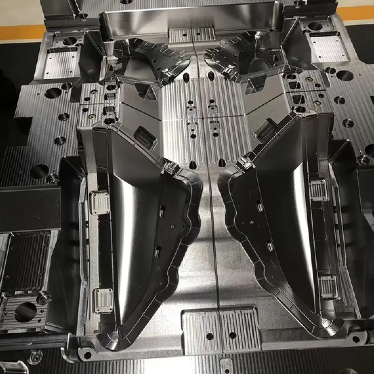
In automotive lamp manufacturing, dimensions are not only about whether a part looks correct. They affect how all related parts connect and function together. Mounting points, clips, sealing edges, and welding surfaces all depend on precise tooling.
If those areas are not controlled carefully, downstream assembly becomes more difficult. Workers may need to apply more force, parts may not align properly, and rejection rates can rise in later stages rather than during initial molding.
Uneven wall thickness often leads to shrinkage differences, warpage, and cooling problems. A well-designed mould helps us control resin flow in a way that supports uniform wall thickness and better structural consistency.
This is particularly important for lamp housings and optical components, where shape stability affects both function and appearance. Once thickness variation becomes too great, process adjustment alone may not be enough to solve the issue.
A mould that performs well during sampling but loses precision in mass production is not truly reliable. Good tolerance control must remain effective over repeated cycles. This depends on machining quality, mould steel, structural design, and fitting accuracy.
That is why we always consider long-term dimensional consistency rather than focusing only on initial sample approval.
One advantage of a high-quality mould is that the process becomes less sensitive. Small fluctuations in material batch, room temperature, or machine condition are less likely to create major defects. That wider process window helps us maintain stable production more easily.
In contrast, a low-quality mould usually narrows the process window. Small variations cause large quality changes, and production teams spend more time reacting to problems than preventing them.
The following defects are often strongly influenced by tooling condition and design:
Warpage
Short shot
Flash
Burn marks
Shrinkage
Surface scratches during ejection
Poor assembly fit
Dimensional inconsistency
When these defects happen repeatedly, production cost rises quickly through scrap, rework, and delayed delivery.
Cooling is sometimes underestimated when people discuss mould quality. In fact, cooling design is closely tied to cycle time, deformation control, and dimensional repeatability.
A part may look acceptable immediately after molding, but if the cooling is uneven, internal stress and shape instability may appear later. This can affect trimming, assembly, or sealing performance.
When cooling channels are designed well, heat leaves the mould more evenly. That allows us to maintain part shape while also keeping the production cycle efficient. In mass production, that balance is extremely important.
Poor cooling design often forces us to choose between quality and speed. Better mould engineering helps avoid that trade-off.
An auto lamp mould should not only pass trial production. It should remain stable after thousands of cycles. This is where steel quality, wear resistance, and structural strength become very important.
A mould with good durability helps us maintain stable output over a longer period. Repair intervals are easier to predict, and the production plan becomes more reliable.
Low-quality moulds often appear acceptable at the beginning, but hidden problems grow over time. Wear at parting lines, instability in moving components, or gradual loss of surface quality can all raise maintenance frequency.
That maintenance does not only create repair cost. It also affects machine utilization, labor planning, and delivery schedules. In many cases, those indirect losses are more serious than the repair itself.
When mould accuracy is strong, parts match more consistently in downstream assembly. This reduces manual correction and improves overall line flow. Operators can assemble with more confidence and less force.
For auto lamps, this matters because many components must align precisely for sealing, fastening, and final appearance. Stable tooling helps maintain that fit relationship.
Reflectors, housings, and other lamp components may go through coating, ultrasonic welding, or additional inspections. If the mould produces unstable geometry or inconsistent surfaces, those later processes become more difficult to control.
A good mould supports not just molding quality, but total production quality across the full process chain.
It is natural for buyers to compare mould prices carefully. However, in actual production, the lowest tooling price does not always create the best business result. A cheaper mould may cause:
higher scrap
more rework
longer cycle times
more operator intervention
more frequent downtime
greater delivery risk
Over time, these problems can easily exceed the original savings.
Instead of asking only how much a mould costs, we prefer to ask how it will perform in mass production. This is a more practical way to judge value. Stable performance, lower defect rates, and reduced maintenance often bring stronger long-term returns than a lower initial quotation.
Auto lamp mould quality impacts production in almost every practical way. It influences efficiency, defect rates, surface finish, dimensional consistency, assembly reliability, maintenance frequency, and long-term manufacturing cost. For us, mould quality is not a background technical detail. It is a core factor in whether production can remain stable and competitive.
When the mould is designed and built to a high standard, production becomes easier to manage and product quality becomes more consistent. That is why choosing the right mould solution matters from the beginning. If you would like to learn more about practical auto lamp mould solutions and manufacturing support, we recommend contacting Taizhou Huangyan Guangdian Technology Co., Ltd. for further information.
Q: How does auto lamp mould quality affect production efficiency?
A: High-quality auto lamp moulds help reduce machine adjustments, lower downtime, and improve cycle stability, which makes production more efficient.
Q: Why is mould precision important in automotive lamp manufacturing?
A: Mould precision affects dimensions, assembly fit, sealing performance, and overall product consistency, especially in automotive lamp parts.
Q: Can mould quality affect the surface finish of auto lamp parts?
A: Yes. Better mould polishing, cavity accuracy, and structural stability help reduce flash, haze, flow marks, and other appearance defects.
Q: Why is a high-quality auto lamp mould worth the investment?
A: A high-quality auto lamp mould can reduce scrap, maintenance, and hidden production costs, creating better long-term manufacturing value.


