
- All
- Product Name
- Product Keyword
- Product Model
- Product Summary
- Product Description
- Multi Field Search
Views: 0 Author: Site Editor Publish Time: 2026-06-18 Origin: Site
Reject rates are the silent profit killer in injection molding. Every lens with a flow mark, every housing that warps, every light guide with a bubble—those parts go straight to scrap. Multiply that by thousands of cycles, and the cost is staggering. The root cause of these defects is almost always the mold. A standard mold produces inconsistent parts. A high-precision mold produces identical, flawless parts cycle after cycle. This is why automotive lighting manufacturers increasingly demand high-precision mold solutions from their injection mold manufacturer. Let us examine exactly how precision tooling drives yield rate improvement, and why it pays for itself faster than you might think.
Yield rate means the percentage of parts that pass quality inspection without rework. A 95% yield rate means 5 out of every 100 parts are rejected. For a high-volume production line running 10,000 parts per day, that is 500 rejects daily. Each reject wastes material, machine time, labor, and inspection resources. If each part costs $2 to produce, that is $1,000 per day in pure waste. Over a year of production, that exceeds $300,000.
Automotive lighting components—especially transparent lenses and light guides—have some of the strictest quality standards in plastic injection molding. Defects that would be acceptable in a toy or a storage bin are not acceptable in a headlight lens. Achieving a 98% or 99% yield rate requires a high-precision mold engineered for optical applications.
Every injection molding defect traces back to a mold-related cause. Here are the most common defects in automotive lamp parts and how mold precision eliminates them.
Defect | Root Cause in the Mold | How High-Precision Mold Solves It |
|---|---|---|
Flow marks / streaks | Poor gate design or rough cavity surface | Mirror-grade polishing (Ra 0.02μm) and optimized gate geometry |
Bubbles / voids | Inadequate venting | Micro-venting slots (0.01mm) strategically placed |
Warpage | Non-uniform cooling | Multi-zone conformal cooling channels with temperature control |
Short shot | Improper venting or gate size | Mold flow analysis to size gates and vents correctly |
Flash | Worn parting line or low clamping force | Hardened steel (50+ HRC) and precision-machined parting surfaces |
Splay (silver streaks) | Moisture trap or shear degradation | Proper venting and gate design to reduce shear |
Dimensional variation | Loose tolerances on mold components | CNC machining to ±0.001mm and CMM verification |
A precision injection mold manufacturer addresses each of these root causes during the design and fabrication phase. The result is a mold that produces clean, consistent parts from the first shot.
Mold accuracy refers to how closely the machined components match the design dimensions. Standard industrial molds may hold tolerances of ±0.05mm. High-precision molds for automotive lighting hold tolerances of ±0.005mm or better.
Why does this matter? Every moving part of the mold—ejector pins, slides, cores—fits into a cavity with clearance. If the clearance is too loose, the component wobbles, leading to inconsistent wall thickness or flash. If the clearance is too tight, friction causes wear or sticking.
A high-precision mold maintains consistent clearances across all cycles. Ejector pins move smoothly without binding. Slides lock into position without play. The parting line seals perfectly. This mechanical consistency translates directly to part consistency.
Consider an example: a light guide strip with critical optical surfaces. If the core and cavity shift by 0.02mm, the wall thickness varies. That variation changes how light travels through the strip, creating bright and dark spots. In a high-precision mold, that shift does not happen. Every part has identical wall thickness, ensuring uniform illumination.
For transparent lamp parts, surface finish is arguably the most critical factor. A rough cavity surface diffuses light instead of transmitting it. Visible tool marks, scratches, or orange peel texture will appear on every part molded from that cavity.
Surface finish standards for auto lamp molds:
Application | Required Ra | Equivalent Finish |
|---|---|---|
Headlight outer lens | 0.01-0.02μm | Diamond buffed mirror |
Signal light lens | 0.02-0.04μm | High polish |
Light guide strip | 0.01-0.02μm | Optical grade |
Housing (non-optical) | 0.4-0.8μm | Standard polish |
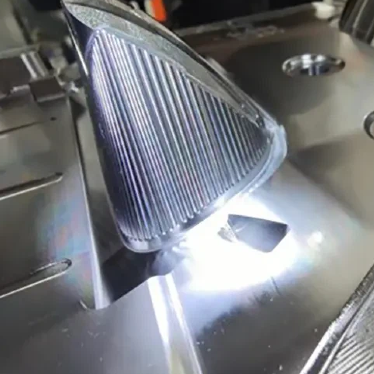
A high-precision mold for optical parts is polished to mirror-grade. This requires skilled mold makers using specialized equipment. Guangdian Technology achieves Ra 0.02μm finishes on all optical surfaces. The result: lenses that are 95% transparent with no visible distortion.
Uneven cooling is a primary cause of warpage. When one section of the part solidifies faster than another, internal stresses pull the part out of shape. In a lamp housing, warpage means poor sealing with the mating cover. In a lens, warpage creates optical distortion.
Standard molds use simple straight-line cooling channels. A high-precision mold uses conformal cooling—channels that follow the part contour. This design maintains uniform temperature across the entire cavity.
Benefits of advanced cooling:
Uniform shrinkage in all directions
Reduced residual stress
Lower warpage (reject reduction of 30-50%)
Faster cycle times (20-30% reduction)
Guangdian Technology designs multi-zone cooling circuits with 8-12 channels per mold half. Temperature sensors monitor each zone. The result is a mold that produces flat, dimensionally stable parts every cycle.
A manufacturer of automotive signal light lenses was experiencing 15% reject rates with their existing mold. Defects included flow marks, bubbles, and slight warpage. They commissioned Guangdian Technology to build a high-precision mold with:
Mirror-grade polish (Ra 0.02μm)
Hot runner with valve gate for precise fill
Multi-zone conformal cooling
Micro-venting (0.01mm slots)
Hardened S136 steel
After installing the new mold, the results were dramatic:
Metric | Before (Standard Mold) | After (High-Precision Mold) | Improvement |
|---|---|---|---|
Yield rate | 85% | 97.5% | +12.5% |
Cycle time | 65 seconds | 48 seconds | -26% |
Reject parts per shift | 150 | 25 | -83% |
Annual scrap cost* | $450,000 | $75,000 | -$375,000 |
*Based on 10,000 parts/day, 250 days/year, $1.20 part cost
The high-precision mold paid for itself in less than six months through reduced scrap alone.
Investing in a high-precision mold costs more upfront—typically 30-50% higher than a standard mold. But the long-term savings from improved yield rate, faster cycles, and lower maintenance quickly offset the initial premium.
ROI calculation example:
Cost Factor | Standard Mold | High-Precision Mold |
|---|---|---|
Initial mold cost | $30,000 | $45,000 |
Expected tool life (cycles) | 200,000 | 500,000+ |
Yield rate | 85% | 97.5% |
Cycle time (seconds) | 65 | 48 |
Annual scrap cost | $450,000 | $75,000 |
Annual maintenance cost | $10,000 | $5,000 |
Total annual operating cost | $460,000 | $80,000 |
The $15,000 higher mold cost is recovered in the first two weeks of production. After that, the high-precision mold saves over $380,000 per year.
Major automotive lighting suppliers have zero tolerance for defects. They require:
PPM (parts per million) defect rates below 100
100% traceability of each part to mold cavity
Documentation of mold flow analysis and CMM reports
Mold life certification for 500,000+ cycles
These requirements cannot be met with standard molds. Only high-precision molds from qualified injection mold manufacturers can deliver the consistency and reliability demanded by Tier 1 suppliers.
Guangdian Technology has supplied high-precision molds to automotive lighting manufacturers serving OEMs like Volkswagen, Ford, Toyota, and BMW. Their molds are designed for 500,000+ cycles, with full quality documentation and mold flow simulation reports.
While the mold is the most critical factor, other elements also affect yield rate. A precision injection mold manufacturer will advise on:
Material drying: PC and PMMA must be dried to below 0.02% moisture. An integrated drying system prevents splay and bubbles.
Process optimization: Using scientific molding techniques to establish robust process windows.
Automated inspection: In-line vision systems to detect defects immediately.
Preventive maintenance schedules: Regular cleaning and lubrication to maintain mold precision.
Guangdian Technology provides training and support to help customers optimize their entire production process, maximizing the yield benefits of their high-precision mold.
Yield rate is not just a quality metric—it is a direct driver of profitability. A high-precision mold from an experienced injection mold manufacturer eliminates the defects that plague standard tooling: flow marks, warpage, bubbles, and dimensional variation. By holding tighter tolerances, achieving mirror finishes, balancing cooling, and incorporating micro-venting, a high-precision mold consistently produces parts that pass inspection. The initial investment is higher, but the payback in reduced scrap, faster cycles, and lower maintenance is compelling. Guangdian Technology designs and builds high-precision molds specifically for automotive lighting applications. Ready to lower your reject rates and improve your bottom line? Contact Guangdian Technology to discuss your high-precision mold project.


