- All
- Product Name
- Product Keyword
- Product Model
- Product Summary
- Product Description
- Multi Field Search
Views: 0 Author: Site Editor Publish Time: 2026-06-18 Origin: Site
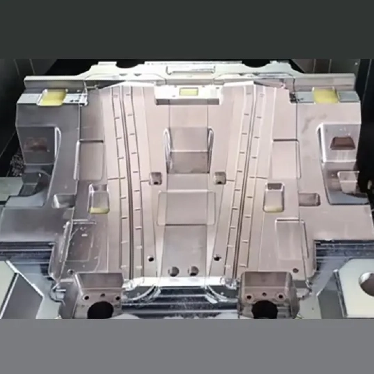
Turn signals, side markers, and reflex reflectors look simple, but their molds are anything but. These automotive lighting components must project light clearly and evenly—without distortion, dark spots, or visible flow marks. Achieving that starts with the Precision Injection Mold for Automotive Signal Lights. This article walks you through the critical design elements: gate placement, cooling, venting, and surface finish.
Signal lights and lenses are smaller than headlights, but their optical demands are just as strict. They must meet regulatory brightness and color standards. Any defect—bubbles, sink marks, or weld lines—can cause light scattering or uneven illumination.
A precision injection mold for these parts must deliver:
Optical clarity with no visual distortion
Dimensional stability for proper assembly
Repeatable quality over millions of cycles
The difference between an acceptable lens and a superior one lies in mold design details.
Gate location directly affects the optical zone. For transparent PC/PMMA mold applications, the gate must be placed in non-critical areas—typically at the edge or behind a mounting feature that will be hidden after assembly.
Common gate types for signal light molds:
Submarine gate (tunnel gate): Cuts off automatically, leaves a small mark, ideal for cosmetic surfaces.
Hot runner gate: No sprue waste, excellent for multi-cavity molds, but requires precise temperature control.
Simulation software (mold flow analysis) is essential here. It shows how the melt front advances. You will see potential weld lines, air traps, or over-packing before cutting steel.
Uneven cooling causes warpage, residual stress, and optical distortion. For injection mold for automotive lenses, the cooling system must be carefully engineered.
Key cooling design principles:
Multi-zone water channels – separate circuits for core, cavity, and hot areas.
Conformal cooling – using 3D-printed or machined channels that follow the part contour.
Balanced flow – equal coolant temperature entering and exiting each zone.
A well-designed cooling system reduces cycle time and ensures consistent part quality. Some signal light molds achieve 45–60 second cycles with proper cooling.
Trapped air causes burn marks, incomplete filling, and surface defects. Transparent parts show these flaws immediately.
Venting design rules for automotive lighting mold:
Vent depth: typically 0.01–0.03mm, located at the last point of fill.
Vent width: 3–6mm for efficient air escape without plastic flashing.
Multiple vents – along the parting line and around ejector pins.
Poor venting leads to "gas burns" that ruin the lens. It also increases injection pressure and machine wear.
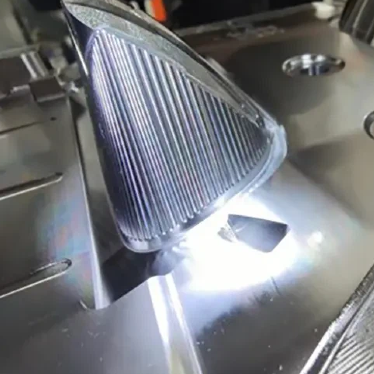
Light scattering is the enemy of signal lenses. The surface finish of the mold cavity directly determines the lens's transparency.
Standard finishes for optical-grade molds:
Application | Surface Finish | Ra Value | Polishing Method |
|---|---|---|---|
Non-optical areas | Standard polish | 0.1–0.2μm | Mechanical |
Optical surfaces | Mirror-grade | 0.02μm | Diamond buffing |
Light guide texture | Engineered texture | – | EDM or etching |
Mirror-grade polishing eliminates micro-scratches and ensures light passes through without diffraction.
The mold design must be optimized for the specific polymer. Both PC and PMMA are common, but they behave differently.
PC (Polycarbonate) : Higher melt temperature (280–320°C), requires better venting, more wear-resistant steel (e.g., H13). Excellent impact strength for exterior signal lights.
PMMA (Acrylic) : Lower melt temperature (220–250°C), better flow, but more brittle. Used for interior lenses or when high transparency is paramount.
Design the runner system and venting accordingly.
A precision injection mold is not ready until it passes rigorous testing. The mold maker should conduct:
Mold flow analysis – virtual verification of filling, cooling, and warpage.
Sample molding – using the customer's specified resin and machine.
Dimensional inspection – CMM measurement of critical features.
Optical inspection – light transmission and clarity checks.
Only after these steps should the mold be shipped.
Guangdian Technology has extensive experience in injection mold for automotive signal lights. Their engineering team uses advanced mold flow software to optimize gate locations and cooling channels. They achieve mirror-grade finishes (Ra 0.02μm) on optical surfaces and use H13 or S136 steel for durability.
Each custom mold is tested before delivery, with full dimensional and optical reports provided. They support multi-cavity designs for high-volume production and offer 12-month warranties.
Designing a Precision Injection Mold for Automotive Signal Lights requires expertise in gate placement, cooling, venting, surface finish, and material behavior. Get any of these wrong, and the lenses will have defects that compromise safety and aesthetics. Guangdian Technology specializes in these demanding molds, combining advanced engineering, quality materials, and rigorous testing. Need a PC/PMMA mold for your next signal light project? Contact Guangdian Technology to discuss your design and production requirements.