- All
- Product Name
- Product Keyword
- Product Model
- Product Summary
- Product Description
- Multi Field Search
Views: 0 Author: Site Editor Publish Time: 2026-11-06 Origin: Site

Unplanned downtime and premature tool degradation are the leading causes of margin erosion in high-volume plastic manufacturing. Operating molds until failure results in flash, short shots, dimensional variations, and catastrophic tool damage. Without a standardized maintenance protocol, manufacturers face unpredictable repair costs and compromised production schedules.
Transitioning from reactive repairs to a structured, cycle-based preventative maintenance (PM) program requires a rigorous framework. Tooling assets represent massive capital investments. Protecting that investment means moving away from run-to-failure mentalities. You need a systematic approach that catches minor wear before it escalates into major mechanical failure.
This guide provides a technical, actionable checklist for maintaining mold integrity, extending tool life, and ensuring consistent part quality. We cover daily in-press inspections, major overhaul procedures, and specialized protocols for complex automotive tooling.
Tooling failure carries a severe financial penalty. You must compare the predictable cost of scheduled downtime against the exponential costs of emergency tool repair. Emergency repairs halt production lines. They cause missed delivery SLAs and force manufacturers to scrap thousands of defective parts. Scheduled injection mold maintenance allows you to control downtime. It transforms unpredictable emergencies into planned operational workflows. A robust PM program ensures continuous production flow and protects your profit margins.
| Maintenance Approach | Operational Impact | Financial Consequence | Part Quality |
|---|---|---|---|
| Reactive (Run-to-Failure) | Unplanned line stoppages, emergency tool room requests | High expedite fees, massive scrap costs, lost revenue | Inconsistent, high defect rates before failure |
| Proactive (Cycle-Based PM) | Scheduled downtime during off-peak shifts | Predictable labor and parts budget | Consistent dimensions, zero flash, stable process |
Neglected maintenance directly correlates to specific, measurable part defects. When vents become clogged with polymer residue, trapped gas ignites under pressure. This causes diesel burns on the molded part. Worn guide pins and bushings create alignment issues. This misalignment leads to parting line mismatch and excessive flash. Degraded cooling channels cause uneven mold temperatures. Uneven temperatures result in warped parts and extended cycle times. Tracking these quality metrics helps pinpoint exact maintenance failures.
Establishing a baseline expectation for mold longevity is mandatory. Industry standards dictate that SPI Class 101 molds should exceed one million cycles. Achieving this baseline depends entirely on your maintenance execution. Without regular lubrication, cleaning, and component replacement, even premium P20 or H13 tool steel will gall and degrade. Proper maintenance dictates whether a mold reaches its engineered lifespan or fails prematurely at half its expected cycle count.
Level 1 maintenance happens while the mold remains in the injection molding machine. Operators must perform these checks every shift to catch immediate issues.
Level 2 requires removing the mold from the press for a thorough bench inspection in the tool room. Technicians use specialized tools like brass scrapers, micrometers, and torque wrenches.
A major overhaul involves the complete disassembly of the mold. This process restores the tool to its original baseline condition.
Develop and deploy a structured, downloadable template across all your manufacturing facilities. This standardizes the upkeep and repair processes. A unified template ensures every technician follows the exact same procedures. It must clearly define pass/fail criteria for every shift. Standardized checklists eliminate ambiguity in maintenance hand-offs between shifts. They ensure nothing gets overlooked during routine or major inspections.
Mechanical systems endure the highest friction and stress. Assess guide pins and bushings for scoring or excessive clearance using micrometers. Inspect slides, lifters, and angle pins. Ensure they actuate smoothly and retain proper lubrication. Verify the structural integrity of all fastening hardware. Check stripper bolts, clamp plates, and manifold bolts for proper torque specifications. Loose bolts lead to catastrophic plate separation during high-pressure injection.
Maintain a dedicated safety stock of the approximately 24 most common high-wear parts. Immediate access to these parts prevents extended downtime. Prioritize inventory for cores, springs, guide pins, inserts, sprue bushes, sprue puller pins, slider plates, and stripper bolts. When a component fails, having the replacement on hand keeps production moving without waiting weeks for custom machining.
Thermal management dictates cycle times and part quality. Pressure test all cooling circuits to identify internal leaks or compromised O-rings. Evaluate hydraulic core pull cylinders for seal degradation and fluid leaks. Verify the injection molding machine's hydraulic oil quality and cleanliness. Degraded machine oil can prematurely destroy mold cylinder seals. Measure water flow rates at the manifold. Verify Temperature Control Unit (TCU) calibration to detect scale buildup or blockages that could cause localized hot spots. Monitor water pH levels and use biocides to prevent algae growth inside the channels.
Electrical failures in hot runner systems cause immediate material degradation. Test all manifold heaters and nozzle heaters. Ensure they show correct resistance and continuity. Check the amp draw under load to verify heater band health. Verify thermocouple accuracy using calibrated multimeters. Inspect all wiring harnesses for pinched cables or degraded insulation. Clean the hot runner manifold thoroughly. Inspect valve gate pins for wear, ensuring they seat perfectly to prevent drool or stringing.
| System Category | Component | Inspection Action | Frequency | Pass/Fail Criteria |
|---|---|---|---|---|
| Mechanical | Guide Pins & Bushings | Measure clearance, check for galling | 10,000 Cycles | Clearance within CAD tolerance; zero visible scoring. |
| Cooling | Conformal Channels | Flow rate test, pressure test | Daily / 100,000 Cycles | GPM matches baseline; holds pressure for 10 mins without drop. |
| Electrical | Thermocouples | Resistance and continuity check | 20,000 Cycles | Temperature reads within +/- 2°F of actual TCU output. |
| Mechanical | Ejector Pins | Visual inspection, lubrication check | Daily | Smooth actuation; no plastic flash down the pin bore. |
| Hot Runner | Valve Gate Pins | Check seating and tip wear | 100,000 Cycles | Pin seats flush; no material drool or stringing observed. |
Automotive tooling presents unique logistical and technical challenges. These molds are massive, often requiring presses exceeding 3,000 tons. Performing automotive injection mold maintenance requires specialized lifting equipment like heavy-duty overhead cranes and magnetic lifters. Rigorous safety protocols are mandatory. Technicians must secure large mold halves with safety straps and locking blocks before stepping between the platens. The sheer scale of these tools means minor alignment issues compound into massive part defects. Sequential valve gating systems require meticulous timing checks to ensure weld lines are pushed to non-visible areas.
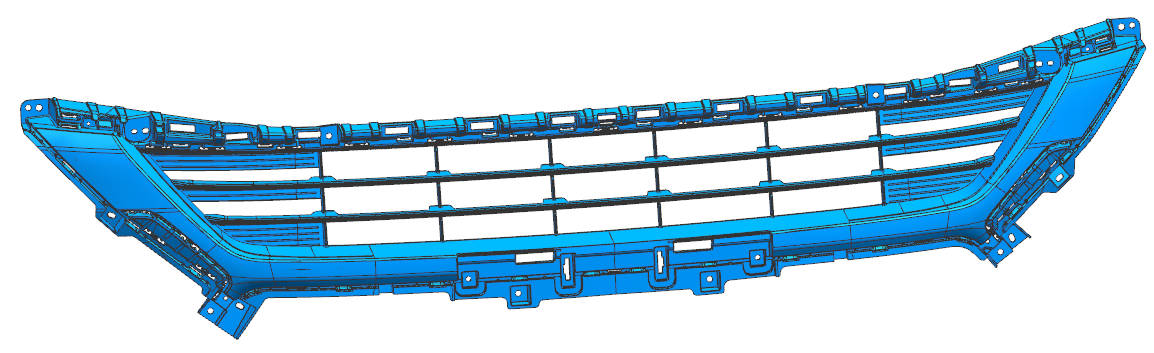
Bumper molds are characterized by their massive size and deep-draw geometry. Proper automotive bumper mold maintenance focuses heavily on the ejection and cooling systems. You must maintain large lifter mechanisms to ensure they do not bind during the deep ejection stroke. Ensuring uniform cooling across massive surface areas is required to prevent bumper warpage. Technicians must frequently check for core shift, as the high injection pressures required to fill a bumper can push large cores out of alignment over time. Guide pillars must be greased with high-load lithium grease to handle the extreme tonnage.
Lighting components demand absolute optical clarity. Therefore, auto lamp mold maintenance revolves around preserving SPI A-1 or A-2 surface finishes. Technicians must follow strict protocols for polishing using diamond paste. They must prevent micro-scratches by using chemical-resistant gloves and face protection gear alongside specialized, non-abrasive cleaning cloths. Venting maintenance is hyper-critical here. Ultra-tight venting must be kept perfectly clean to prevent gas burns on clear polycarbonate or acrylic parts. Even microscopic residue will cause optical distortion in the final lens, leading to immediate part rejection.
Interior and exterior trim components rely on aesthetics. Maintaining an automotive trim injection mold means preserving complex texturing and tight parting lines. Technicians must evaluate inserts carefully. Any wear on the parting line will result in flash. Flash on a textured trim piece ruins the aesthetic finish and usually cannot be trimmed cleanly without leaving a visible scar. Regular ultrasonic cleaning is required to pull outgassing residue out of the deep grain textures without damaging the steel. Chemical etching patterns must be protected from aggressive solvents.
You must evaluate a tooling partner long before the mold is commissioned. Demand specific maintenance deliverables from your injection mold manufacturing service during the design phase. Look for detailed PM schedules tailored to the specific tool. Request a recommended spare parts list with lead times. Ensure they provide comprehensive mold manuals that include CAD data, cooling circuit diagrams, and hot runner wiring schematics. These documents form the foundation of your internal maintenance program.
A reputable plastic injection mold manufacturer will initiate a "resume card" or digital twin for the mold before shipping. This document acts as the tool's medical history. It must include detailed records, statistics of its use, and a complete care history. The resume card tracks steel types, hardness ratings, coating specs, and initial baseline measurements. It logs shot counts, cycle time baselines, peak injection pressures, and tonnage requirements. Technicians use this baseline to measure wear over time. Updating the resume card after every PM cycle ensures total traceability.
Assess the service provider's ability to handle major refurbishments. As molds age, they require more than just cleaning. They need engineering changes, welding, and re-machining. Your partner must have the capability to reverse engineer worn components. They need to manufacture replacement parts that keep the mold compliant with the original part prints. A strong partner will offer rapid turnaround times for Level 3 overhauls to minimize your production downtime.
Using abrasive pads, wire brushes, or incorrect solvents can destroy SPI A-1 finishes in seconds. Scratched molding surfaces transfer directly to the plastic part, causing immediate quality rejections. To mitigate this risk, standardize all approved cleaning supplies across your facility. Mandate the exclusive use of brass tools, wooden scrapers, and non-abrasive cloths for cavity and core cleaning. Remove all steel tools from the polishing area entirely.
Failing to log cycle counts and maintenance actions leads to missed PM intervals. Relying on operator memory guarantees that tools will be run to failure. Mitigate this by implementing a centralized Computerized Maintenance Management System (CMMS). Integrate this system directly with the press cycle counters. Tie the CMMS to your digital resume cards so work orders trigger automatically when a mold hits its 10,000 or 100,000 cycle threshold.
Poor injection molding machine maintenance transfers wear directly to the mold. Dirty hydraulic oil destroys mold cylinder seals. Fluctuating TCU temperatures cause thermal shock to the tool steel. To mitigate this, align your mold PM schedules with your machine PM checklists. Ensure oil quality checks, filter replacements, and TCU validations are performed concurrently with mold inspections. The machine and the mold function as a single ecosystem.
Tasking inexperienced operators with complex mold maintenance leads to damaged components. Untrained hands often roll parting line edges or crush delicate vents during reassembly. Establish strict certification levels for your maintenance technicians. Clearly delineate what tasks can be done in-press by operators versus what requires a certified toolmaker in the tool room. Restrict access to major disassembly procedures to highly trained personnel only.
Proactive injection mold maintenance is an investment in asset preservation and quality assurance, not an overhead expense. A rigorous checklist prevents catastrophic failures and ensures predictable production yields. Protecting your capital tooling investments from premature degradation requires discipline and standardized procedures.
When evaluating tooling strategies, prioritize partnerships with an injection mold manufacturing service that integrates maintenance documentation, structured templates, and lifecycle planning into the initial mold design phase. A strong partner provides the necessary framework to support your internal maintenance teams.
A: Major maintenance (Level 3) is typically recommended every 100,000 to 250,000 cycles, depending on the mold's SPI classification, the abrasiveness of the resin, and the complexity of the tool.
A: A resume card is a detailed historical record for a specific mold. It tracks cycle counts, maintenance performed, detailed statistics of its use, replaced parts, damage history, and dimensional changes over the tool's lifecycle.
A: A standard maintenance inventory should stock roughly 24 critical parts, with the most frequently replaced components including ejector pins, core inserts, guide pins, bushings, springs, O-rings, slider plates, stripper bolts, and sprue puller pins due to constant friction and thermal cycling.
A: Auto lamp molds require optical-grade surface finishes. Maintenance must be performed in clean environments using specialized non-abrasive tools and proper PPE (like chemical-resistant gloves and face protection gear) to prevent micro-scratching, and venting must be meticulously cleaned to prevent optical defects from trapped gas.
A: Yes, Level 1 maintenance—such as wiping down parting lines, lubricating leader pins, and visually inspecting for damage—should be performed daily or between shifts while the mold remains in the injection molding machine.
A: Scale buildup and rust in cooling channels restrict water flow, leading to uneven mold temperatures. This causes extended cycle times, part warpage, and dimensional instability. Regular descaling and verifying machine-side temperature controls are required to maintain thermal efficiency.